
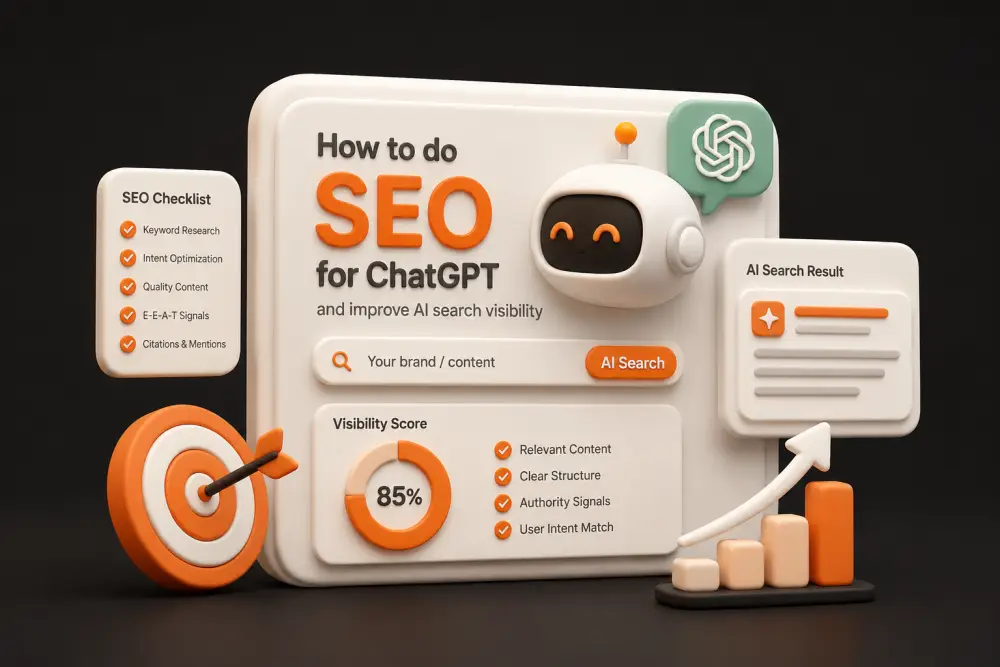
Why SEO for ChatGPT matters now
AI search is changing how people discover information. Users are no longer just browsing search results and comparing links. Increasingly, they are asking questions directly to AI tools and expecting complete answers in return.
That shift changes what visibility actually means.
Instead of competing for a position on a search engine results page, your content now needs to be selected, interpreted, and surfaced inside AI-generated responses. If your content is not included in those answers, it becomes much harder to earn attention, even if it performs reasonably well in traditional search.
Research from Nielsen Norman Group found that generative AI is actively reshaping search behaviour, with users increasingly relying on AI-generated responses to discover and evaluate information
Shift from search results to AI-generated responses
Traditional search engines present a list of links. Users choose what to click, compare sources, and build their own understanding.
AI systems work differently. Tools like ChatGPT, Gemini, and Perplexity summarise information and present a direct response instead of a page of search results. That means users often get what they need without visiting multiple websites.
This creates a new visibility challenge for brands. You are no longer competing only for rankings. You are competing to become part of the answer itself.
A recent academic study on generative search found that AI-generated search experiences retrieve and surface information differently from traditional search engines, often relying on different source sets and content signals altogether.
In practical terms, content now needs to be:
- Easy to understand
- Structurally clear
- Contextually relevant
- Trusted enough to be referenced
The websites that perform best are often the ones that make information easy to extract and interpret, both for users and AI systems.
Why traditional SEO alone is no longer enough
Traditional SEO still matters. Technical SEO, crawlability, internal linking, site structure, and authority signals remain important foundations.
Google has made this clear in its
helpful content guidance, where it emphasises creating useful, people-first content rather than content designed purely to manipulate search visibility.
Search systems are also becoming more granular. With
passage ranking, Google can evaluate and surface individual sections of a page based on how well they match intent. This means a well-structured section can outperform an entire page that lacks clarity.
As AI-generated content becomes easier to produce, search systems increasingly rely on signals related to:
- Experience
- Expertise
- Authority
- Trustworthiness
Industry analysis from BrightEdge notes that strengthening E-E-A-T signals is becoming increasingly important for visibility in AI-driven search experiences because AI systems need stronger confidence in the information they surface. (brightedge.com)
In other words, content that feels generic is becoming easier to ignore.
What “SEO for ChatGPT” actually means
One of the biggest misconceptions is that ChatGPT SEO is a completely separate discipline.
It is not. SEO for ChatGPT is really an evolution of modern SEO. The goal is to create content that AI systems can confidently understand, extract, and reference.
Google’s AI search updates reinforce this shift towards understanding meaning and relationships between topics, rather than relying purely on keyword matching.
The difference is how content is evaluated.
Strong AI-ready content tends to:
- Answer questions directly
- Match search intent clearly
- Demonstrate real expertise
- Use logical structure and formatting
- Cover topics with sufficient depth
A recent GEO (Generative Engine Optimisation) study found that AI search platforms show a strong preference for authoritative, well-structured sources and often evaluate content differently from traditional search engines. (arXiv)
That is why SEO for ChatGPT is not about chasing a new algorithm.
It is about creating content that is genuinely useful, easier to understand, and trustworthy enough to be surfaced in an environment where answers matter more than rankings.
How AI search works and how ChatGPT selects content
If you want your content to appear in AI-generated answers, you need to understand one key shift: AI tools do not rank content in the same way search engines do.
They don’t present options. They construct answers.
That changes the goal of SEO. Instead of asking how to rank higher, the more useful question becomes:
Is this content clear and complete enough to be used as an answer?
How ChatGPT retrieves and generates answers
ChatGPT uses a system often described as retrieval-augmented generation. It retrieves relevant information, interprets the query, and then generates a structured response.
This approach is explained clearly by Pinecone, which outlines how AI systems combine retrieval and generation to produce answers.
Because of this, your content is not just being indexed. It is being interpreted and reused. That is why clarity and structure matter so much.
What influences content selection in AI responses
AI systems are selective by design. They aim to produce the most useful answer, not the most comprehensive list of sources.
Instead of relying heavily on traditional ranking signals alone, AI tools look for content that aligns closely with intent and is easy to interpret.
A page might perform reasonably well in search results but still be excluded from an AI-generated response if it does not clearly answer the question.
In practice, three factors tend to stand out:
- Relevance to the query – does the content directly answer the question?
- Clarity of structure – is the answer easy to extract and understand?
- Depth of coverage – does it provide a complete and useful explanation?
AI-driven platforms often prioritise clarity and usefulness over traditional ranking signals, especially when synthesising answers from multiple sources.
The implication is straightforward. Content that tries to do too much at once often performs worse than content that focuses on solving a specific problem clearly.
Make your content work in AI search
Let’s boost your visibility in AI search, optimise your content for LLMs, and leave outdated SEO behind.
Why your content is not appearing in ChatGPT answers
If your content is not appearing in ChatGPT answers, the issue is rarely visibility alone. It is usually a combination of structural gaps, weak authority, and misaligned intent.
Common SEO gaps that limit AI visibility
Most SEO issues in AI search are not technical. They are content-related.
A common pattern we see is content that technically exists but is difficult for AI systems to interpret. This often comes down to three core issues, which are weak structure, limited topical authority, and shallow execution.
- Weak structure
Weak structure is one of the biggest blockers. If your content does not clearly break down ideas into sections, it becomes difficult for AI systems to extract useful answers. Google has already moved towards passage-level ranking, where individual sections are evaluated independently. If your key insights are buried, they are unlikely to surface. - Topical authority
Topical authority is another major factor. AI systems look for consistency across a topic. If your site lacks supporting content around AI search, semantic SEO, and content optimisation, it signals limited authority. - Shallow content
Shallow or generic content is equally problematic. With the rise of AI tools, it has become easier to produce large volumes of content. However, much of it lacks originality or depth. Google has been explicit about this. Its helpful content guidance prioritises content that demonstrates real expertise and provides genuine value, rather than content created primarily for search engines.
Mismatch between search intent and content delivery
Even well-written content can fail if it does not match intent.
AI systems are designed to answer specific questions. If a user asks how to optimise content for AI search and your article spends most of its time discussing general SEO trends, it will not be selected.
This is where many SEO strategies break down. Content is often created around keywords, not actual user needs.
Modern SEO for ChatGPT requires a different approach. You need to:
- Understand the exact question behind the query
- Deliver a clear answer early in the content
- Support that answer with structured, relevant detail
Google’s documentation on ranking systems reinforces this shift. Its systems are designed to prioritise content that directly satisfies user intent, not just content that includes the right keywords.
This is why front-loading answers matters. If your content takes too long to get to the point, it risks being ignored.
Over-reliance on keywords without context
Keywords still play a role in SEO, but they are no longer the primary signal. AI systems interpret meaning, not just terms.
If your content includes the phrase “SEO for ChatGPT” but fails to clearly explain how to optimise for AI search, it will struggle to appear in ChatGPT answers. Context and completeness matter far more than repetition.
Instead of focusing on a single keyword, your content should naturally cover related concepts such as AI search behaviour, content structure, authority building, and optimisation strategies.
How to optimise content for ChatGPT and AI search
At a high level, to optimise for ChatGPT SEO your content must be easy to understand, easy to extract, and genuinely useful.
Align content with AI retrieval patterns
The biggest shift in SEO for ChatGPT is how content is consumed. AI systems do not read entire pages the way users do. They extract specific sections that directly answer a query.
This is why answer-first content matters. Instead of building up to a point, your content should deliver value immediately.
If someone asks how to optimise content for AI search, your page should answer that clearly within the first few lines, not halfway through the article.
Structure content for clarity and extraction
Even strong insights can be missed if they are not structured properly. AI systems rely heavily on formatting to understand and extract information. If your content is difficult to scan, it is also difficult to use.
Use clear headings to separate ideas, and keep explanations concise. Each section should stand on its own and deliver a specific takeaway. This aligns with how Google evaluates content at the passage level, where individual sections can be surfaced independently.
Well-structured content improves both SEO performance and usability. It allows readers and AI systems to quickly identify the most relevant information without friction.
Build topical authority across related themes
One well-optimised page is rarely enough to perform consistently in AI search.
AI systems look for signals of authority across a topic. If your content only touches on ChatGPT SEO once, it is less likely to be trusted compared to a site that consistently covers related areas.
This is where topic clusters become essential.
Instead of creating isolated articles, build connected content around themes like AI search, SEO for AI, and content optimisation. Internal linking helps reinforce these relationships and improves how search engines interpret your site.
Optimise for entities and semantic relevance
Keywords still play a role in SEO, but they are no longer the primary driver of visibility.
AI systems focus on meaning. They evaluate how topics connect and whether your content provides a complete, useful explanation.
Instead of repeating a single keyword, your content should naturally cover related concepts and provide depth. For example, when writing about SEO for ChatGPT, it should also explore AI search behaviour, content structure, and topical authority.
Is your SEO strategy ready for AI search?
AI search is already shaping how users discover content. The question is whether your strategy is keeping up. If your content is not appearing in ChatGPT responses or AI search engines, it is likely time to rethink your approach.
If you want to understand how your current strategy aligns with these changes, you can get in touch with SEOBoost.
A more structured, future-focused approach can help you improve visibility, strengthen your SEO performance, and stay competitive as search continues to evolve.