
Google Search has changed dramatically over the past few years.
What began as an experiment in Search Labs with the Search Generative Experience (SGE) has evolved into AI Overviews, AI Mode, and a new generation of Generative AI features that are changing how people discover information online. Instead of typing a single keyword and browsing through links, users can now ask complex questions, receive AI-generated summaries, and ask follow-up questions without starting a new search.
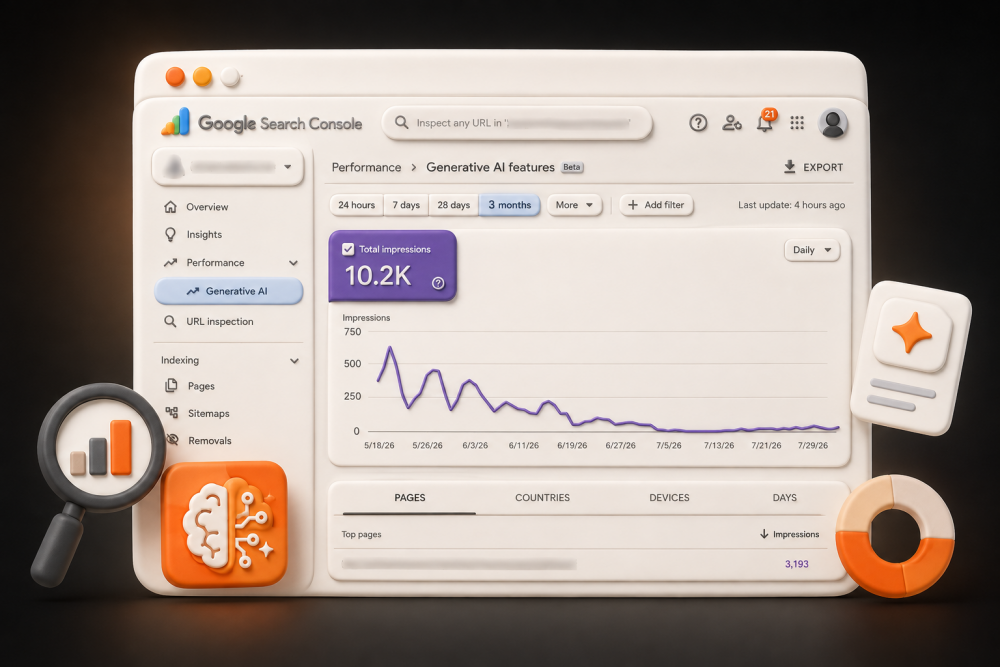
To help website owners understand this shift, Google recently introduced the Search Generative AI Performance report in Search Console. It marks the first time businesses can measure how often their content appears across Google’s Generative AI experiences in Search.
It’s a significant step forward.
But after reviewing Google’s documentation, testing the report, and comparing it with traditional Google Search reporting, we noticed something interesting.
The report tells us that our content appeared.
It doesn’t tell us why.
That missing insight may be one of the biggest challenges for businesses as AI in Search continues to evolve.
Google processes over 5 trillion searches every year, highlighting the scale of search behaviour that AI is beginning to reshape. – Google, 2025 Search announcements
Google says AI Overviews are now used by more than 1.5 billion users every month, making them one of the fastest-adopted search experiences in the company’s history. – Google I/O 2025
Google's Journey From Search Engine to AI Search
Google didn’t become an AI-powered search experience overnight. The transformation has happened gradually, with each update changing how people search, how Google presents information, and how businesses earn visibility.
From keywords to conversations
Traditional search engines were designed around keywords.
You searched for something like:
- best payroll software philippines
Google returned a list of web pages.
You clicked one.
The journey was relatively straightforward.
With AI Overviews and AI Mode, people can ask questions naturally, receive an answer, then continue the conversation without starting over.
Imagine someone begins with a simple question:
How much is the minimum wage in the Philippines?
Google provides an answer, which can naturally create the next question.
Minimum wage monthly salary
Minimum wage total per year
Minimum wage updated
When is minimum wage increase effective?
For one hour
In salary
Today
What's that monthly?
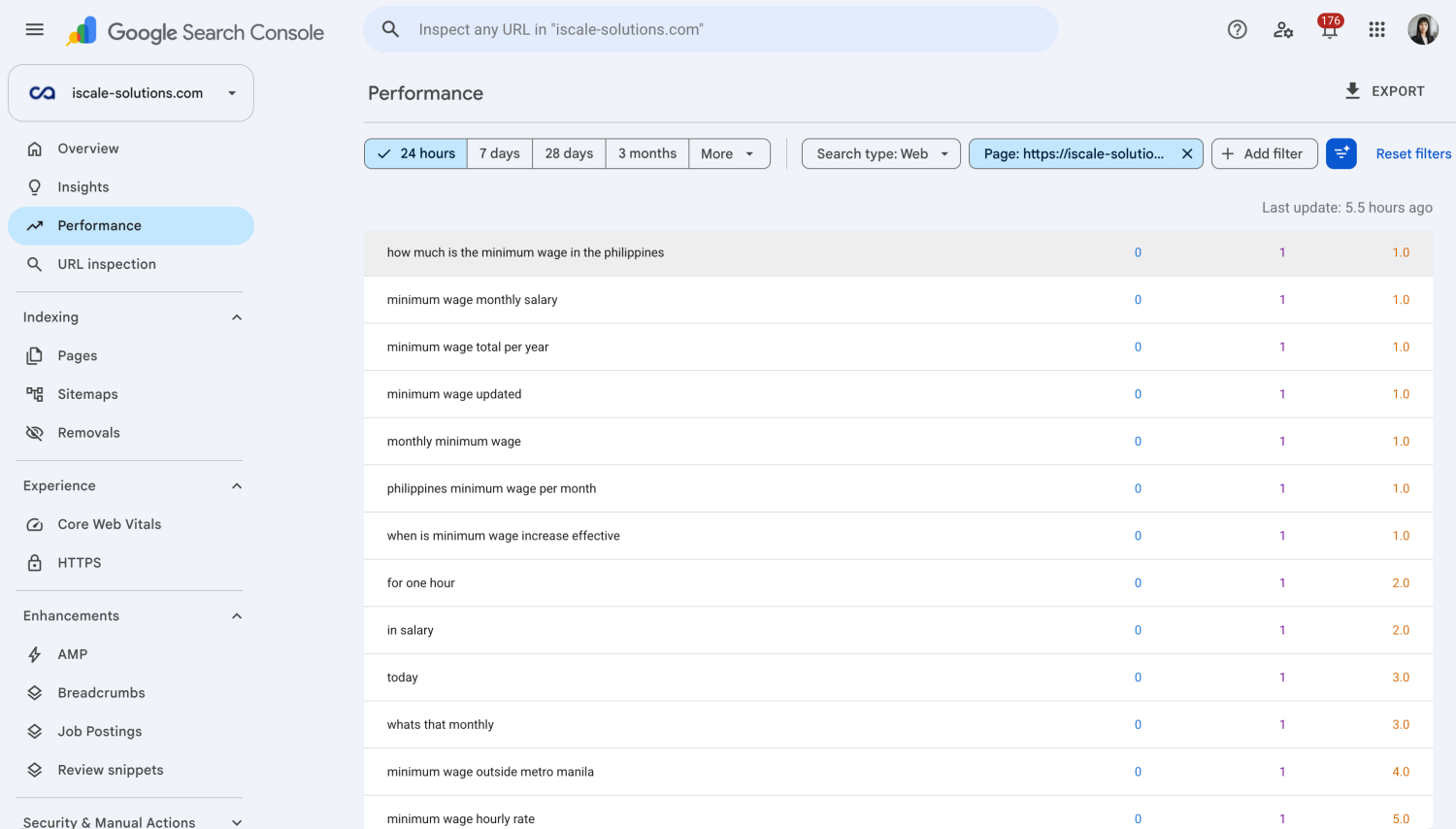
This isn’t an imagined customer journey. It’s based on what we observed in Google Search Console for one of our clients, iScale Solutions. The pattern doesn’t prove these searches came from AI Overviews or AI Mode, but it does highlight how today’s search journeys can unfold as a series of connected follow-up questions rather than standalone keywords.
Looking at these searches individually, some of them appear incomplete or ambiguous.
But viewed together, they tell a different story.
Each question builds on the answer that came before it.
Instead of starting a completely new search every time, users appear to be refining their understanding as new information is presented.
The screenshot below comes from a traditional Search Console performance report for a single landing page. While Google has not confirmed these searches originated from AI Overviews, AI Mode, or other Generative AI features, they illustrate how search behaviour may be becoming increasingly conversational.
Rather than treating every search as an isolated query, Google is increasingly supporting a journey where users ask follow-up questions, clarify information, and progressively narrow their intent.
This represents a new way to search, where understanding the conversation may become just as important as understanding the original keyword.
How Google's AI Search evolved
Google’s transition happened in several stages.
Search Generative Experience (SGE)
Google first introduced the Search Generative Experience as an experiment in Search Labs, allowing users to test early Generative AI capabilities directly inside search.
This was Google’s first public demonstration that Generative AI in Search could summarize information before users visited websites.
AI Overviews
SGE eventually evolved into AI Overviews, which became part of the standard Google Search results experience.
Instead of showing only links, Google began generating AI responses that combine information from multiple sources while linking back to relevant websites.
This fundamentally changed how businesses appear in search.
Visibility is no longer limited to the familiar blue links.
Your content can now contribute to an AI-generated answer.
AI Mode
Google later introduced AI Mode, expanding conversational search even further.
Instead of starting a brand-new search every time, users can continue asking questions, compare options, upload images and text, and explore topics through multimodal conversations powered by Gemini and other Generative AI models.
For businesses, this means customer journeys are becoming increasingly conversational rather than linear.
Google’s advice for website owners hasn’t changed
Despite these new search experiences, Google’s official guidance remains surprisingly familiar.
According to Google’s Search Central Blog, businesses should continue focusing on:
- Creating helpful, people-first content
- Demonstrating expertise and trustworthiness
- Building technically sound websites
- Providing original insights rather than repeating existing information
In other words, Google isn’t asking businesses to create content specifically for AI.
It’s asking them to create content that’s genuinely useful, whether it’s surfaced in traditional Google Search results, AI Overviews, or future Generative AI features on Google.
What Is Google's Search Generative AI Performance Report?
As Google’s AI search experiences expand, businesses naturally want to know one thing:
Are we actually appearing in AI Search?
To help answer that question, Google recently introduced the Search Generative AI Performance report inside Search Console.
The report is currently available in beta and is rolling out gradually to selected websites before a broader release.
For many website owners, this is the first dedicated reporting feature for measuring visibility across Generative AI features.
What the report measures
The new report focuses on one primary metric:
Impressions
Businesses can also filter data by:
- Landing pages
- Devices
- Countries
- Dates
This gives marketers an early view of how frequently their content appears across Google’s AI-powered search experiences.
What the report doesn’t show
Unlike the traditional Performance report in Search Console, the Generative AI Performance report currently doesn’t include:
- Clicks
- Click-through rate (CTR)
- Average position
- Search queries
That difference immediately caught our attention.
Not because the report is incomplete.
But because Google’s choice of metrics may tell us something about how AI Search is evolving.
One observation we’ve consistently shared with our clients is this:
Impressions have never been “just a vanity metric.”
Before someone can click your website…
Google first has to decide your content deserves to appear.
Whether that happens through traditional rankings, snippets, AI Overviews, or future AI responses, visibility is still the first signal that your content is relevant.
Stay ahead of the next update
If your rankings feel unpredictable or you’re unsure what to fix, we can help. Get in touch to turn Google updates into clear, actionable growth opportunities.
The Insight Google's AI Report Doesn't Show
The new report answers an important question.
Did my content appear in AI Search?
But it doesn’t answer another question that may be even more valuable.
What customer question caused my content to appear?
For businesses trying to improve their SEO strategy, that distinction matters.
Knowing your website received impressions tells you your content was visible.
Knowing why Google selected your content tells you how to improve future content.
Those are two very different insights.
Visibility doesn’t explain discovery
Imagine two businesses each receive 10,000 AI impressions.
Business A understands which customer questions led to those impressions.
Business B only knows the number of impressions.
Which business is better positioned to improve its content creation, strengthen customer journeys, and refine its SEO strategy?
Probably the first.
Because understanding customer intent leads to better decisions than simply measuring visibility.
This is why we believe the next evolution of AI reporting shouldn’t just measure where businesses appear.
It should help businesses understand why they appeared.
Why this matters beyond SEO
This isn’t only an SEO issue.
It’s a business issue.
Every marketing decision starts with understanding customers.
What are they asking?
What information are they missing?
What helps them make better decisions?
As Google AI continues transforming search experiences, those customer questions become even more valuable than individual keywords.
What Does This Mean for Businesses?
Google hasn’t explained why certain AI metrics are missing from the Search Generative AI Performance report. So the ideas below are our interpretation based on Google’s product direction, documentation, and how conversational search appears to be evolving.
They’re not confirmed by Google, but they offer a useful framework for thinking about where AI in Search may be heading.
Conversations don’t fit into a single query
Traditional Google Search was built around a simple model.
A user entered one query.
Google returned search results.
The user clicked a page.
Today’s AI Overview and AI Mode experiences are much more dynamic.
Someone might begin by asking:
- “What’s the minimum wage in the Philippines?”
After reading Google’s AI response, they naturally continue with:
- “What about Makati?”
- “Does that include overtime?”
- “Is that updated this year?”
These follow-up questions only exist because the previous answer created new context.
From a reporting perspective, that raises an interesting challenge.
Should Google attribute the website impression to the first question?
The latest question?
Or the entire conversation?
As Google’s new AI capabilities continue to evolve, measuring conversational intent may become much more complex than measuring individual keywords.
Attribution is becoming more complicated
Traditional search often followed a straightforward journey.
One search.
One ranking.
One website.
Today’s Generative AI features don’t always work that way.
An AI response may combine information from several URLs, summarize multiple sources, and generate a single answer using insights from different publishers.
That makes attribution significantly harder.
If five websites contribute to one AI-generated answer, deciding which page deserves credit for the conversation becomes far less straightforward than assigning a click to a single search result.
This may explain why Google has chosen to introduce Generative AI Performance reporting gradually, starting with visibility rather than more advanced engagement metrics.
Privacy may influence future reporting
Another consideration is user privacy.
Unlike traditional keywords, conversational searches often contain much richer context.
People may ask highly specific questions about their finances, health, business challenges, or personal situations.
As Generative Artificial Intelligence becomes more conversational, Google’s reporting will likely need to balance useful insights with its own privacy policy commitments and user expectations.
That could influence how much conversational data is eventually exposed inside Search Console.
What Businesses Should Do Today
Although AI search reporting is still evolving, businesses don’t need to wait for Google to release more metrics before improving their strategy.
The fundamentals of great SEO remain the same. The difference is that businesses should now think beyond keywords and start thinking about conversations.
Build content that answers the next question
One of the biggest opportunities with AI Overviews isn’t answering the first question.
It’s anticipating the second, third, and fourth.
Instead of publishing content that targets a single keyword, create resources that naturally guide readers through an entire topic.
For example, rather than writing an article that simply explains minimum wage calculations, consider adding:
- Frequently asked questions
- Practical examples
- Common exceptions
- Local scenarios
- Related comparisons
This helps both users and Google’s Generative AI features understand your content more comprehensively.
Use Search Console differently
Most marketers open Search Console to check rankings and clicks.
Start using it to identify conversation opportunities instead.
Review your most important landing pages and look for unexpected or fragmented search terms.
While these aren’t necessarily generated by AI Overview or AI Mode, they can reveal valuable clues about:
- Questions customers ask after reading your content
- Missing explanations
- Content gaps
- Opportunities for new articles
Instead of treating them as keywords to optimize for, treat them as conversation starters.
Continue following Google’s official guidance
Despite the rise of Generative AI, Google’s recommendations for website owners haven’t fundamentally changed.
The company still encourages businesses to:
- Create people-first content.
- Demonstrate expertise and experience.
- Publish original insights.
- Maintain strong technical SEO.
- Make information easy to understand.
Whether your content appears in traditional Google Search, AI Overviews and AI Mode, or future Generative AI experiences, helpful content continues to be the strongest long-term strategy.
Use Generative AI as an assistant, not a replacement
Many teams are beginning to use Generative AI and other Generative AI tools for research, brainstorming, outlining, and improving productivity.
These tools can accelerate content creation, but they shouldn’t replace human expertise.
The businesses that stand out in AI search are unlikely to be the ones publishing the most AI-generated content.
They’re more likely to be the ones publishing the most useful, accurate, and experience-driven content.
According to Google’s Search Central guidance, creators should focus on producing helpful, reliable, people-first content regardless of whether it appears in traditional search results or Generative AI features on Google. – Google Search Central
What We'd Like Google To Report Next
Understanding that single insight could help businesses:
- Create more relevant content.
- Improve customer journeys.
- Identify gaps in existing resources.
- Better align SEO with customer intent.
Instead of optimizing around isolated keywords, businesses could optimize around the conversations that actually lead to discovery.
Other metrics we’d love to see
As Google’s reporting matures, it would also be valuable to see:
- Top conversation themes that surfaced a page.
- Follow-up questions users asked before visiting a website.
- AI citation frequency by page.
- Visibility trends across different Generative AI experiences.
- Performance comparisons between traditional search and AI features on Google Search.
These insights would give businesses a much deeper understanding of how people search and discover brands through modern search experiences.
So, What Should Businesses Focus On Now?
Google has made AI Search measurable.
That’s a major milestone.
But measuring visibility is only one part of understanding how customers discover your business.
As Google Search continues evolving through AI Overviews, AI Mode, and other Generative AI features, the businesses that succeed won’t simply focus on rankings or impressions.
They’ll focus on understanding the questions customers ask before they ever become customers.
That’s where the biggest opportunities are likely to emerge.
If your business wants to stay ahead of these changes, SEOBoost can help you build an SEO strategy that prepares your content for both traditional search and Google’s evolving AI experiences. Get in touch with our team for tailored guidance on improving your visibility in AI-powered search.