

AI SEO tools promise faster content, better rankings, and smarter workflows. But in reality, most businesses are still unsure which tools actually improve results.
The challenge is not access to tools. It is knowing which AI SEO tool genuinely improves visibility, content performance, and long-term growth.
Search has changed. Between Google AI Overviews, AI-generated answers, and semantic search, ranking alone is no longer the goal. What matters now is how your content performs across both search engines and AI systems.
This guide breaks down the best AI SEO tools in 2026, explains how they work in practice, and helps you choose based on real business outcomes, not feature lists.
What Are AI SEO Tools And Why Do They Matter Now?
AI SEO tools are designed to support content optimisation, search visibility, and SEO workflows using real search data and machine learning.
They are not a shortcut to rankings. When used properly, they help you:
Improve content quality
Align with search intent
Scale SEO efforts without losing consistency
From experience, most SEO gains today come from better execution, not more content. This is where AI tools are useful.
How AI SEO tools actually work
Most AI SEO tools analyse live search results to understand:
What topics competitors cover
How content is structured
What users expect from a page
They then guide you to:
Build stronger content briefs
Improve structure and readability
Cover relevant subtopics
Optimise content based on real data
This makes your content more aligned with how search engines evaluate quality.
What has changed with AI search and visibility
Search is no longer a simple list of links.
Users now get answers from:
Google AI Overviews
Featured snippets
AI answer engines like ChatGPT
This means your content needs to:
Answer questions clearly
Be structured logically
Demonstrate expertise and trust
If your content is vague or generic, it is less likely to appear in these environments.
Why traditional SEO tools are no longer enough
Traditional SEO tools still play an important role. They help with:
Keyword research
Backlink analysis
Technical SEO
But they do not always help you write better content.
AI SEO tools fill that gap by focusing on:
Content quality
Relevance
Semantic depth
Where AI tools fit into a modern SEO workflow
A realistic SEO workflow today looks like this:
Identify search intent and topics
Create a structured content brief
Optimise content before publishing
Improve content based on performance
AI tools support steps 2 and 3. They help you execute faster without lowering quality.
What To Look For In The Best AI SEO Tools
Choosing the right AI SEO tool is less about features and more about fit.
The best tools solve a specific problem in your workflow. The wrong ones add complexity without improving results.
Content optimisation vs content generation
This is one of the most misunderstood areas.
Many AI tools focus on generating content. But content generation alone does not improve rankings.
From practical SEO experience:
Generated content often lacks depth
It may not match search intent
It rarely builds authority on its own
Content optimisation tools are usually more valuable because they help improve what you already create.
AI search and semantic optimisation capabilities
Modern SEO is built around semantic relevance, not just keywords.
A strong AI SEO tool should:
Suggest related topics and entities
Help structure content logically
Improve alignment with search intent
This is what improves visibility in both traditional and AI search results.
Integration with your existing SEO tools
Most teams already use tools like Semrush or Ahrefs.
Your AI SEO tool should:
Fit into your workflow
Enhance existing data
Not duplicate basic functionality
Otherwise, it becomes an extra cost without real value.
Data accuracy and real search insights
One of the biggest risks with AI tools is generic output.
Reliable tools:
Use real SERP data
Reflect actual user behaviour
Provide actionable insights
If a tool cannot explain why a recommendation matters, it is not helping your SEO.
Automation vs strategic control
Automation is useful, but it should not remove human input.
The best tools:
Speed up repetitive SEO tasks
Still allow editorial control
Support decision-making
SEO still requires judgement. AI should assist, not replace it.
Best AI SEO Tools in 2026: Comparison list
There is no universal “best” AI SEO tool. Each platform solves a different problem.
The goal is to match the tool to your content strategy and growth stage.
Comparison table: top ai SEO tools at a glance
| Tool | Best for | Strength | Limitation |
|---|---|---|---|
| Surfer SEO | Content optimisation | Strong SERP analysis | Can feel rigid |
| Semrush AI | All-in-one SEO | Data + AI insights | Higher cost |
| Ahrefs | Research | Reliable data | Limited AI optimisation |
| Clearscope | Content quality | Simple and effective | Expensive |
| Frase | Content briefs | Fast workflows | Less depth |
| MarketMuse | Strategy | Deep topic insights | Complex |
| Scalenut | Content + SEO | Balanced features | UI limitations |
| NeuronWriter | Budget SEO | Affordable | Limited integrations |
1. Surfer SEO
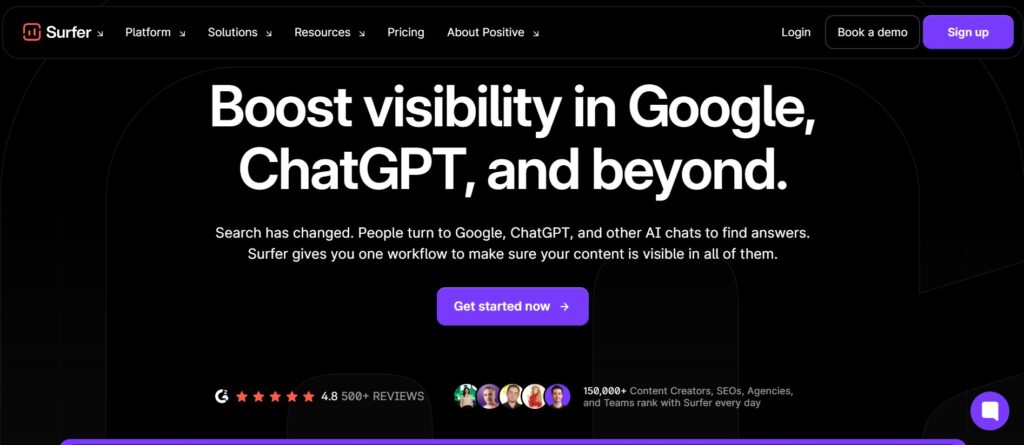
Surfer SEO is a cloud-based AI SEO tool designed to improve content performance using real search data.
It combines SERP analysis with AI-driven optimisation, helping businesses create SEO content that performs across both search engines and AI platforms.
What It Does
| Area | What Surfer SEO Does |
|---|---|
| Content optimisation | Provides real-time SEO scoring and recommendations |
| AI content creation | Generates SEO-optimised articles using SERP data |
| Content audits | Identifies gaps and improvement opportunities |
| Keyword research | Builds topic clusters and content strategies |
| AI visibility | Supports optimisation for AI models like ChatGPT |
Key Features
- Content Editor: Real-time optimisation based on structure, keywords, and NLP terms
- Surfer AI: AI writer that creates SEO-optimised content using live SERP insights
- Content Audit: Improves existing pages by identifying gaps and missing elements
- Keyword Planner: Helps structure content around topics and semantic relevance
How It Works
- Enter a target keyword and location
- Analyse top-ranking pages and SERP patterns
- Get actionable optimisation recommendations
- Improve content using real-time scoring
Surfer integrates with Google Docs, WordPress, and tools like Jasper, making it easy to fit into existing workflows.
It also supports optimisation for AI platforms like ChatGPT and Perplexity, helping improve visibility across AI search environments.
Surfer SEO is a practical choice for teams focused on content optimisation and AI visibility. It works best when used to refine and improve content, rather than relying on it purely for automation.
2. Semrush
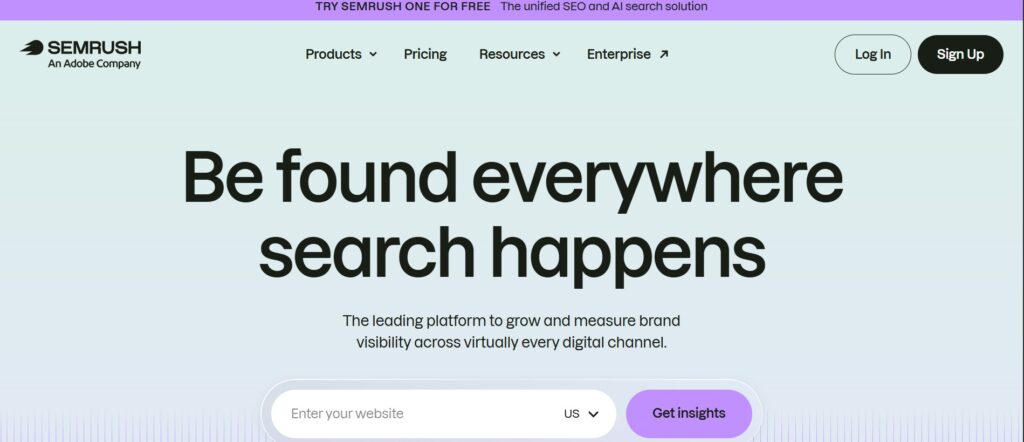
Semrush AI is an all-in-one AI SEO platform that combines traditional SEO tools with AI visibility tracking and optimisation.
It is designed for businesses that want to manage SEO, content, and AI-driven search performance in one place, rather than using multiple disconnected tools.
What It Does
| Area | What Semrush AI Does |
|---|---|
| SEO tracking | Tracks rankings and AI-generated visibility |
| Competitor analysis | Analyses SEO, PPC, and backlink strategies |
| Keyword research | Provides search volume, difficulty, and insights |
| Technical SEO | Identifies site issues and performance gaps |
| Content optimisation | Generates briefs, clusters, and recommendations |
Key Features
- SEO & AI visibility tracking: Monitors performance across search engines and AI platforms
- Competitive intelligence: Analyses competitor keywords, ads, and backlinks
- Keyword research tools: Discovers opportunities and ranking difficulty
- Site audit: Identifies technical SEO issues and bottlenecks
- Content optimisation: Generates SEO briefs and compares content to top-ranking pages
How It Works
- Track keyword rankings and AI visibility in one dashboard
- Analyse competitors across SEO and paid channels
- Identify technical and content gaps
- Optimise content using data-driven insights
Semrush brings together SEO and AI workflows, making it easier to manage search performance and visibility across AI platforms at scale.
Semrush AI is best suited for teams that need a complete SEO toolkit with AI capabilities. It works well for businesses managing multiple SEO processes and looking to improve visibility across both traditional search and AI environments.
3. Ahrefs
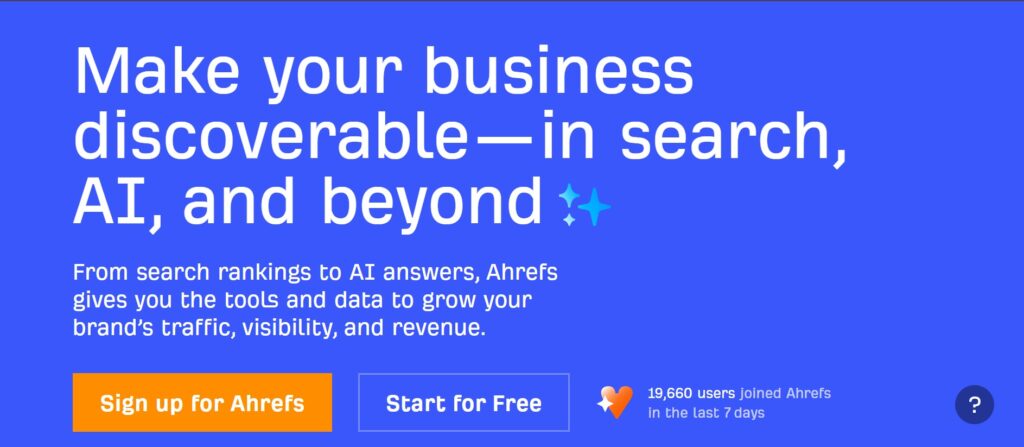
Ahrefs is a comprehensive SEO tool and AI SEO platform powered by large-scale data. Originally built as a backlink analysis tool, it has evolved into a full SEO suite that supports both traditional search optimisation and emerging AI visibility needs.
It is widely used by SEO professionals to analyse performance, uncover opportunities, and improve visibility across search engines and AI-driven platforms.
What It Does
| Area | What Ahrefs Does |
|---|---|
| Backlink analysis | Analyses backlink profiles and link opportunities |
| Keyword research | Provides search volume, difficulty, and click data |
| Competitor analysis | Tracks organic traffic and paid strategies |
| Technical SEO | Crawls websites to detect issues and errors |
| AI visibility | Monitors brand presence across search and AI environments |
Key Features
- Site Explorer: Analyses backlinks, organic traffic, and competitor strategies
- Keywords Explorer: Provides keyword data, difficulty scores, and click metrics
- Brand Radar: Monitors brand visibility and sentiment across search and AI platforms
- Site Audit: Detects technical SEO and on-page issues
- Content tools: Supports content research, topic discovery, and optimisation workflows
How It Works
- Crawl and analyse large-scale web data
- Track keyword rankings and competitor performance
- Identify backlink and content opportunities
- Fix technical SEO issues and improve site health
Ahrefs is powered by a massive web crawler, enabling deep insights into organic search results and competitive landscapes. This is one of the best AI SEO tools for data-driven research and competitive analysis.
It is ideal for businesses that need strong insights to guide strategy, especially when improving SEO performance, backlink profiles, and visibility across search and AI environments.
4. Clearscope
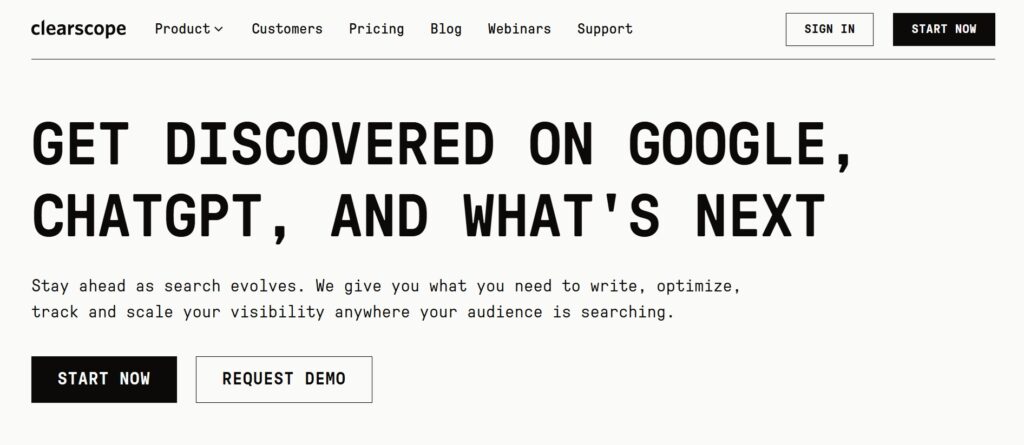
Clearscope is an AI-powered SEO and content optimisation tool designed to help teams research, write, and improve high-performing SEO content.
It focuses on content quality, semantic relevance, and readability, making it a strong choice for businesses that want to produce content that performs well in both search engines and AI-driven search environments.
What It Does
| Area | What Clearscope Does |
|---|---|
| Content optimisation | Grades content based on SERP data and relevance |
| SEO content quality | Improves readability and topic coverage |
| AI visibility | Tracks how content appears in AI-generated answers |
| Content briefs | Creates structured outlines for SEO content |
| Content monitoring | Identifies decay and optimisation opportunities |
Key Features
- Content Editor: Grades content from A to F based on competitor analysis and semantic coverage
- AI search visibility: Monitors how content appears in platforms like ChatGPT and other AI search engines
- Search intent summaries: Highlights what users are actually looking for in search results
- Outline Builder: Generates structured, SEO-optimised content outlines
- Content monitoring: Integrates with Google Search Console to track performance and content decay
How It Works
- Analyse top-ranking content and SERP patterns
- Generate optimisation recommendations and content outlines
- Improve content based on semantic relevance and readability
- Monitor performance and update content over time
Clearscope helps teams align content with search intent, SEO best practices, and AI-driven search behaviour.
It is best suited for teams that prioritise high-quality SEO content, topical authority, and consistent performance, especially in competitive industries.
5. Frase
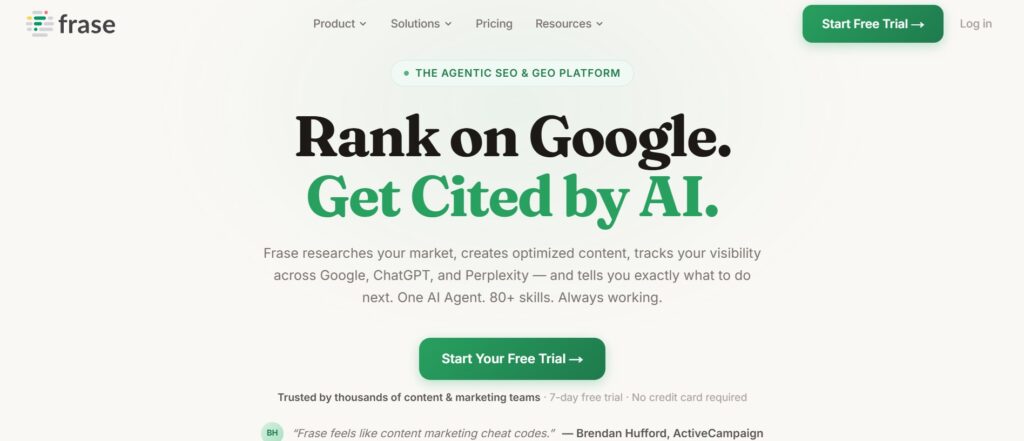
Frase AI is an AI-powered SEO and content intelligence platform designed to streamline content research, creation, and optimisation.
It combines briefing, writing, and optimisation into one workflow, helping teams produce SEO content that aligns with search intent and performs across search engines and AI platforms.
What It Does
| Area | What Frase AI Does |
|---|---|
| Content research | Analyses top search results and identifies gaps |
| Content briefs | Generates structured briefs based on SERP data |
| AI content creation | Produces SEO-optimised drafts quickly |
| Content optimisation | Improves structure and search intent alignment |
| Programmatic SEO | Supports scalable content generation |
Key Features
- Automated research & briefs: Analyses top Google results to map search intent, questions, and content gaps
- GEO optimisation: Structures content for AI search engines like ChatGPT and Perplexity
- AI writing & optimisation: Generates drafts aligned with brand voice and SEO goals
- Programmatic SEO: Enables scaling content production using templates
- Real-time optimisation: Provides suggestions to improve content performance
How It Works
- Analyse search results and extract key insights
- Generate a content brief with topics and questions
- Create SEO-optimised drafts using AI
- Refine content based on optimisation recommendations
Frase reduces manual work across research, writing, and optimisation, making SEO workflows faster and more efficient.
It is ideal for teams that want to automate SEO tasks, scale content production, and improve alignment with search intent, especially in fast-moving content strategies.
6. MarketMuse
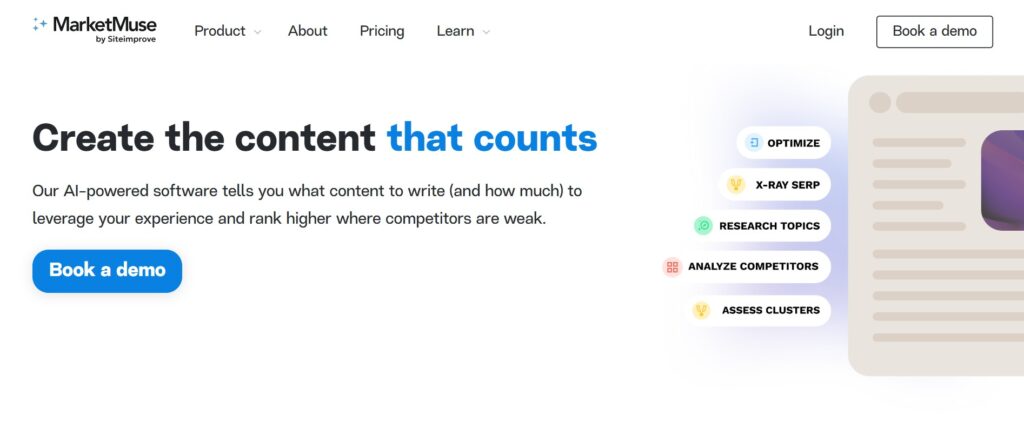
MarketMuse is an AI-powered SEO and content intelligence platform designed to automate content research, planning, and optimisation.
Unlike tools focused only on keywords, it analyses your entire website to help build topical authority, identify content gaps, and improve long-term SEO performance.
It is best suited for teams focused on strategic content growth and visibility across search and AI-driven platforms.
What It Does
| Area | What MarketMuse Does |
|---|---|
| Content strategy | Identifies topic gaps and authority opportunities |
| Content planning | Prioritises what to create or update |
| Content optimisation | Scores content against competitors |
| Personalised insights | Evaluates ranking difficulty based on your site |
| AI visibility | Supports stronger content depth for AI search |
Key Features
- Content Inventory & Auditing: Scans your site to identify outdated content, gaps, and authority opportunities
- Personalised difficulty: Scores ranking potential based on your domain, not generic metrics
- Automated content briefs: Generates outlines with user intent, topics, and structure
- Real-time optimisation: Scores content and suggests improvements as you write
- Topic modelling: Helps build deeper, more connected content for semantic SEO
How It Works
- Analyse your website content and topical coverage
- Identify gaps and prioritise high-impact opportunities
- Generate structured content briefs and outlines
- Optimise content using scoring and recommendations
MarketMuse focuses on improving content depth, authority, and strategic alignment, rather than just individual page optimisation.
It is ideal for businesses that want to move beyond basic optimisation and build long-term SEO growth, stronger authority, and better performance across search and AI environments.
7. Scalenut

Scalenut is an AI-powered SEO and content marketing platform that combines keyword planning, content creation, and optimisation into one workflow.
It is designed to help businesses, agencies, and SEO professionals scale content production while improving search performance and AI visibility.
By blending generative AI with real SEO data, Scalenut supports end-to-end content creation and optimisation without needing multiple tools.
What It Does
| Area | What Scalenut Does |
|---|---|
| Content research | Analyses SERPs and builds content strategies |
| Content creation | Generates long-form SEO content and assets |
| Content optimisation | Scores and improves content performance |
| Keyword planning | Builds clusters and topic structures |
| AI visibility | Optimises for search engines and AI platforms |
Key Features
- Cruise Mode: End-to-end workflow that builds outlines and generates SEO-optimised drafts from a target keyword
- Content Optimiser: Real-time SEO scoring with readability and keyword recommendations
- Keyword Planner: Groups keywords into clusters for structured content strategies
- AI copywriter: Creates blogs, ads, and social media content using AI
- GEO optimisation: Helps content perform across AI search engines like ChatGPT and Perplexity, not just traditional SERPs
How It Works
- Enter a target keyword
- Analyse competitors and SERP data
- Generate structured outlines and drafts
- Optimise content using real-time scoring
Scalenut streamlines the entire SEO and content workflow, making it easier to automate SEO tasks and scale production.
It is ideal for teams that want an all-in-one AI SEO platform to scale content quickly while maintaining SEO performance and visibility across AI and search environments.
8. Neuronwriter
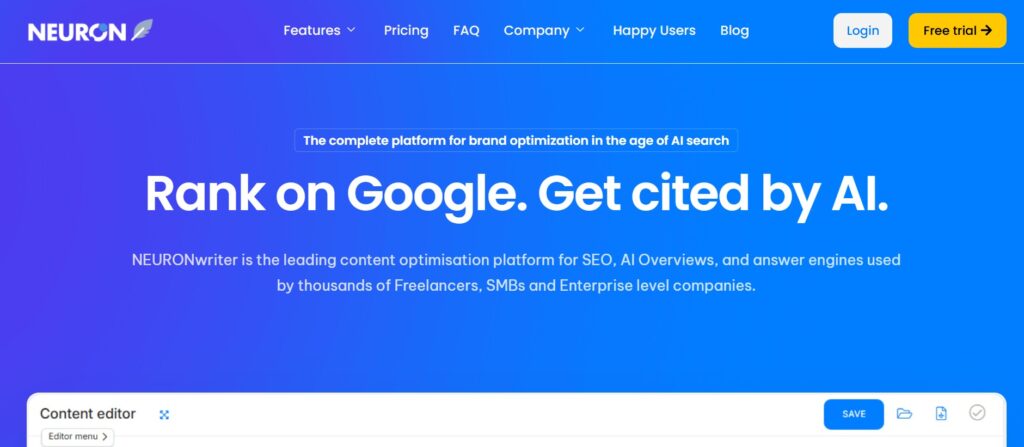
NeuronWriter is an AI-powered SEO and content optimisation tool designed to help users create high-ranking SEO content using data-driven insights.
It focuses on analysing search engine results (SERPs) and recommending the exact keywords, headings, and semantic phrases needed to improve content performance and search visibility.
What It Does
| Service type | Average monthly cost | Pricing model | Best for |
|---|---|---|---|
| SEO for ecommerce | £800 – £3,000+ | Monthly retainer | Long-term organic growth |
| Paid ads (Google & Shopping) | £500 – £5,000+ (plus ad spend) | % of ad spend or flat fee | Driving immediate sales |
| Social media advertising | £500 – £4,000+ (plus ad spend) | % of ad spend | Brand awareness and promotion |
| Email marketing | £300 – £2,000 | Monthly or per campaign | Retention and repeat purchases |
| Conversion rate optimisation (CRO) | £800 – £3,500 | Monthly retainer | Improving conversion rates |
| Influencer marketing | £200 – £10,000+ | Per campaign | Reaching new audiences |
| Content marketing | £500 – £3,000 | Monthly or per piece | Supporting SEO and brand growth |
| Full-service ecommerce marketing | £2,000 – £10,000+ | Monthly retainer | Complete growth strategy |
Key Features
- SERP-based competitor analysis: Analyses top Google results to guide content structure and optimisation
- Real-time content scoring: Measures optimisation progress as you write
- AI writing assistant: Supports drafting, rewriting, and summarising content
- AI profiles & humaniser: Customises tone and improves readability to match your brand
- Content management tools: Helps organise projects and export content
How It Works
- Analyse search results and competitor content
- Identify keyword and semantic gaps
- Optimise content using real-time scoring
- Refine content with AI-assisted writing tools
NeuronWriter simplifies SEO and content optimisation workflows, making it easier to improve rankings without complex tools.
NeuronWriter is one of the best AI SEO tools for affordable content optimisation and SERP analysis.
It is ideal for individuals and small teams who want a practical AI SEO tool to improve content quality, rankings, and visibility across search and AI environments without investing in a full enterprise platform.
AI writing tools vs SEO platforms
AI writing tools and SEO platforms serve different purposes.
AI writing tools help with content creation
AI SEO tools improve content performance
Relying only on writing tools often leads to weaker SEO results.
Free AI SEO Tools vs Paid Platforms
Free tools can be useful, but they come with limitations.
When free ai tools are enough
Free tools work well when:
- You are testing ideas
- You have a small content plan
- You are learning SEO basics
Limitations of free ai SEO tools
Most free tools:
- Lack real search data
- Provide generic outputs
- Do not scale effectively
This often leads to inconsistent results.
When to invest in a paid SEO platform
You should invest when:
- SEO is a core growth channel
- You need consistent performance
- You are producing content regularly
Paid tools provide better insights and more reliable optimisation.
How To Choose The Right AI SEO Tool For Your Business
Choosing the right AI SEO tool is less about features and more about fit. The best tool is the one that solves your current bottleneck, not the one with the longest feature list.
A simple way to decide is to start with your primary goal, then narrow down based on your workflow and resources.
Start with your main content goal
If your focus is improving existing content and rankings, prioritise content optimisation tools like Surfer or Clearscope. These help refine structure, relevance, and performance.
If you are producing content at scale, look for tools like Scalenut or Frase. These support content creation and optimisation in one workflow, making it easier to maintain consistency.
If your goal is building long-term authority in a competitive space, MarketMuse is more suitable. It focuses on topic depth, content gaps, and strategic planning.
Then consider how your team works
Your team size and workflow will shape what is practical.
If you are working solo or with limited resources, tools like NeuronWriter offer a simpler, more focused way to improve content without complexity.
For small teams, tools like Surfer or Frase strike a balance between usability and capability.
Larger teams or agencies often benefit from platforms like Semrush, where SEO, content, and performance tracking are managed in one place.
Match the tool to your SEO experience level
If you are early in your SEO journey, choose tools that guide you clearly. Simpler platforms reduce the risk of overcomplicating your workflow.
At an intermediate level, you will benefit from tools that combine data and usability, helping you scale without losing control.
Advanced teams should prioritise data-rich platforms that support deeper analysis, competitive insights, and AI-driven SEO strategy.
Align with your growth priorities
Finally, connect your tool choice to your business outcome.
If your goal is increasing traffic, focus on tools that improve content optimisation and search visibility.
If you want to build authority, choose platforms that support topical depth and semantic SEO.
If efficiency is your priority, invest in tools that help automate SEO tasks and streamline workflows, without reducing quality.
A simple way to decide
If you are unsure, ask:
- What is slowing down our SEO right now?
- Do we need better content or more content?
- Are we lacking strategy, execution, or both?
- Will this tool fit into how we already work?
The right AI SEO tool should make your workflow clearer and your results more consistent, not more complicated.
Stop guessing your SEO strategy
If your content is not performing, the issue is rarely effort. It is alignment. The right tools and strategy fix that quickly.
How AI SEO Tools Impact Content Performance And Rankings
AI tools can improve performance, but only when used correctly.
Improving content optimisation and structure
They help create clearer, more structured content. This improves readability and SEO performance.
Aligning content with search intent and AI answers
They identify gaps and help match user expectations.
This is essential for visibility in AI-driven search results.
Supporting topical authority and semantic relevance
They help connect related topics and build deeper content coverage.
What tools cannot fix without strategy
They cannot replace:
Positioning
Expertise
Authority
Strategy still drives long-term results.
AI SEO Tools And The Future Of Search Visibility
The biggest shift in SEO right now is not ranking volatility. It is where visibility actually happens.
Most teams are still optimising for clicks. But search is increasingly optimised for answers.
AI overviews and zero click search
AI Overviews and answer engines are not just features. They are changing user behaviour at a structural level.
Users are:
- Getting summarised answers instantly
- Skipping traditional result pages
- Trusting aggregated responses over individual sources
From an SEO perspective, this means one thing:
you are no longer competing just for clicks, but for inclusion.
If your content is not selected, summarised, or referenced, it effectively does not exist in that moment.
Visibility beyond traditional rankings
Ranking #1 is no longer a guarantee of visibility.
In many cases, the highest-performing content is:
- Cited in AI-generated answers
- Referenced across multiple sources
- Structured in a way that is easy to extract
Real visibility now sits across:
- Search engines (Google, Bing)
- AI platforms (ChatGPT, Perplexity)
- Answer layers (AI Overviews, snippets)
The shift is subtle but important.
SEO is becoming a distribution problem, not just a ranking problem.
Optimising for AI answer engines
AI models do not “rank” content in the same way search engines do. They select and synthesise.
From practical observation, content that performs well in AI search tends to have:
- Clear, direct answers early in the content
- Strong structure with logical sections
- Consistent terminology and topic coverage
- Minimal fluff or filler
This is why many high-ranking pages still fail in AI environments. They are optimised for keywords, not for extractability.
A useful way to think about it:
Traditional SEO asks: “Can this page rank?”
AI SEO asks: “Can this content be understood and reused?”
Why authority and trust matter more than ever
AI systems compress multiple sources into a single answer. When they do this, they prioritise:
- Trusted domains
- Consistent expertise signals
- Clear, factual content
This creates a compounding effect.
Strong brands:
- Get cited more often
- Appear across multiple queries
- Build visibility beyond individual pages
We are already seeing this in practice.
AI models tend to favour brands they “recognise” over isolated pieces of content.
What this means in practice
The implication is straightforward, but often missed:
- Publishing more content is not enough
- Optimising for keywords alone is not enough
- Even ranking well is not enough
To perform in modern search, your content needs to:
- Be structurally clear
- Demonstrate real expertise
- Cover topics with depth and consistency
- Be easy for AI systems to interpret and reuse
The real role of AI SEO tools here
AI SEO tools are not just about efficiency anymore.
Their real value is helping you:
- Structure content properly
- Identify gaps in coverage
- Align with how AI models interpret information
Used correctly, they help you move from:
- “Creating content” → to building visibility across systems
Is Your SEO Strategy Ready For AI Search?
AI SEO tools can improve how you work. But they will not fix a weak strategy.
Sustainable SEO today requires:
Clear search intent alignment
Strong content structure
Authority and trust signals
Ongoing optimisation
If your content is not performing, the issue is rarely the tool. It is usually the strategy behind it.
At SEOBoost, we help businesses build long-term visibility across both search engines and AI-driven platforms.
If you want to improve your SEO performance, you can contact us to discuss your goals.