
The January 2026 algorithm update has quickly become one of the most talked-about Google algorithm updates in recent memory. If you have been watching your Google Search performance closely, you have likely already seen some unusual movement in ranking.
Early signals from the Search Status Dashboard suggested that this was not just another minor tweak. Instead, it appears to be part of a broader 2026 update cycle that is reshaping how content is evaluated across the search engine.
What makes this update particularly important is how it connects to previous changes, especially the December 2025 core update. Many sites that saw gains late in 2025 are now experiencing volatility, while others are recovering after months of stagnation.
For indie hackers and growing brands, this is a reminder that SEO is not static. Google makes thousands of changes each year, but every so often, an algorithm update comes along that forces you to rethink your entire content strategy.
2026 Core Update and Ranking Shifts
The March 2026 core update appears to be the next phase following the January 2026 core update, and early data points to this being a broad core update rather than a niche adjustment.
What changed in ranking across SERPs
Across multiple projects, we have seen clear ranking shifts in SERPs, particularly for informational queries. Pages that previously held stable positions are now fluctuating daily.
This suggests deeper algorithm changes rather than surface-level adjustments. In simple terms, Google is reassessing what deserves to rank, not just reshuffling existing results.
How this 2026 core update fits into the bigger picture
The 2026 core update seems to build on patterns from recent years. It is not just about keywords anymore. It is about context, intent, and trust.
From what we are seeing, the 2026 core is placing more weight on:
- Content depth and clarity
- Alignment with search intent
- Signals of real expertise
What I have seen across client sites
Across several client sites, especially in competitive niches, the impact has been uneven.
Some pages with strong backlinks but thin content dropped. Meanwhile, pages with genuinely helpful content, even without aggressive link building, started climbing.
This is consistent with what Search Engine Land and Search Engine Roundtable have been reporting. The update is less about gaming the system and more about rewarding substance.
Google Algorithm Updates (2022–2025)
To understand the January 2026 update, you need to look back at the evolution of Google algorithm updates over the past few years.
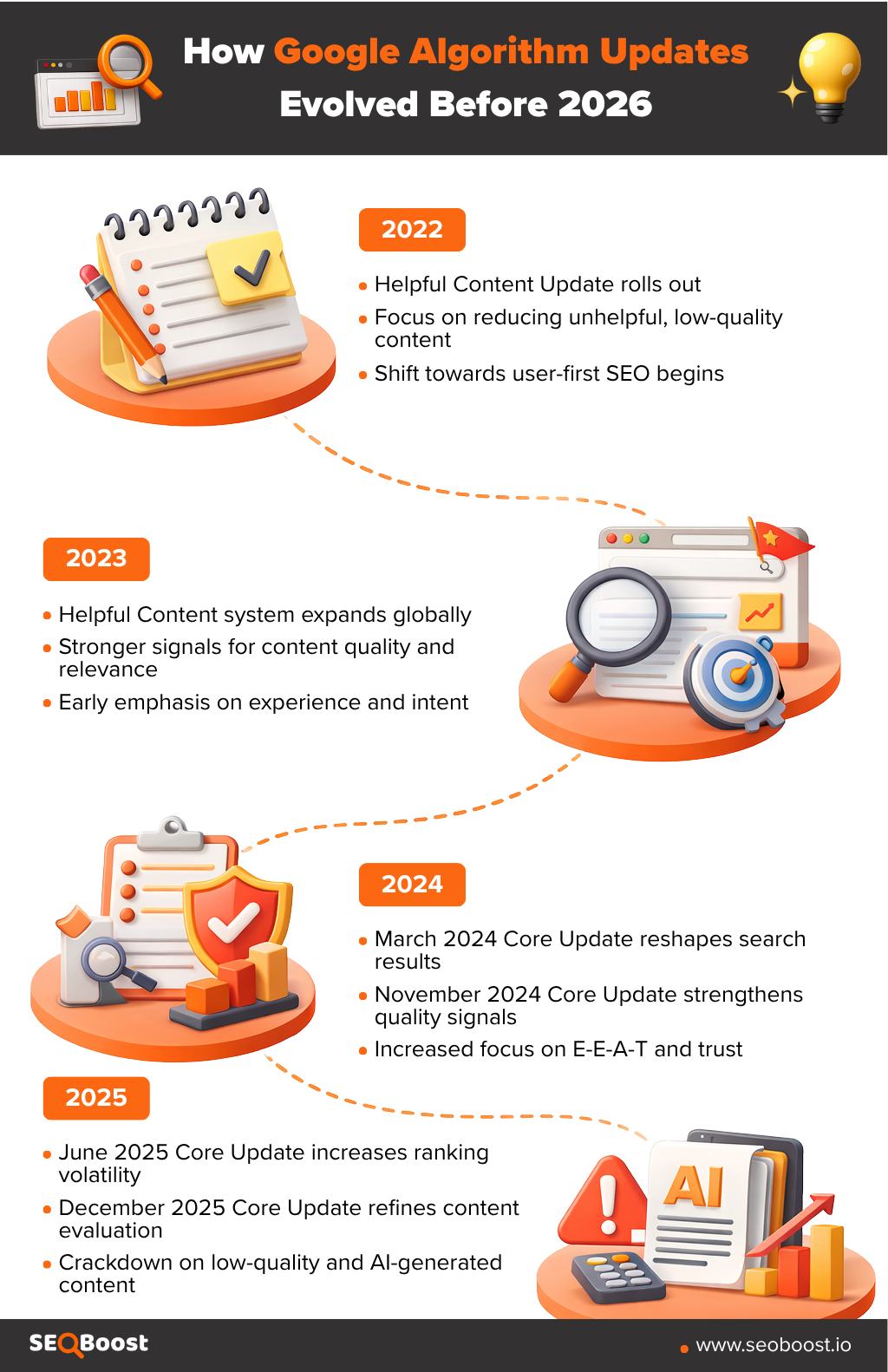
From 2022 to 2023: The rise of helpful content
The 2022 and 2023 updates introduced the idea of helpful content as a core principle. Google began targeting unhelpful content and pages clearly designed just to rank.
This was the start of a shift away from traditional SEO tactics and towards user-first content.
2024: Core algorithm and quality signals evolve
By 2024, especially around the March 2024 changes and the November 2024 core update, Google refined its core algorithm to better evaluate authoritativeness and trust signals.
This is where E-E-A-T started to have a more visible impact on search ranking, particularly in YMYL topics.
2025: A year of aggressive core updates
The 2025 core update cycle, including the June 2025 core update and the December 2025 core update, pushed things further.
We saw:
- More frequent volatility in search results
- Increased focus on content quality over quantity
- Stronger penalties for low-quality content
Many site owners noticed that even well-optimised pages could drop if they lacked depth or originality.
Why 2026 was inevitable
By the time we reached the January 2026 core update, the direction was clear.
Google was no longer just refining its system. It was redefining how updates work entirely.
The goal is simple:
Deliver better answers, faster, with less tolerance for manipulation.
AI in Search: Gemini, AI Overviews, and SERPs
AI is no longer a side feature in Google Search. It is becoming the engine behind it.
Gemini and AI-powered search experiences
Google’s Gemini model is at the centre of this shift. It powers more AI-driven discovery, helping Google understand queries at a deeper level.
This means the search engine is no longer just matching keywords. It is interpreting intent, context, and nuance.
AI Overviews and changing search results
The introduction of AI Overviews is already reshaping search results.
Instead of showing a list of blue links, Google is increasingly providing summarised overviews at the top of the page. These often pull information from multiple sources into a single answer.
For users, this is convenient.
For site owners, it changes everything.
What this means for ranking and visibility
With AI Overviews and evolving SERPs, traditional ranking is no longer the only metric that matters.
You might rank well and still lose clicks if your content is absorbed into an overview or replaced by an AI-generated summary.
From what I have seen, the sites that still perform well tend to:
- Offer unique insights rather than generic answers
- Build strong trust signals
- Avoid relying purely on AI-generated content
A quick reality check from the field
We tested this across a few content hubs recently.
Pages that were rewritten to be more opinionated and experience-driven started appearing more often in featured snippets and occasionally in AI summaries.
Meanwhile, generic, AI-heavy pages struggled, even when technically optimised.
The takeaway is simple.
AI is not killing SEO.
But it is forcing it to grow up.
Struggling to keep up with Google algorithm updates?
AI-Generated Content, Helpful Content, and E-E-A-T
Since the January 2026 algorithm update, there has been a noticeable surge in AI-generated content across the web. It is fast, scalable, and tempting for any business trying to keep up with Google algorithm updates.
But here is the issue.
Google is getting better at spotting patterns. Not just whether content is AI-assisted, but whether it is actually useful.
Helpful content still wins
The principles introduced back in 2022 are now fully embedded in the 2026 core update.
Helpful content means:
- Clear answers to a real query
- Demonstrated experience
- Content that does not feel mass-produced
We have seen pages lose ranking simply because they felt generic, even when they were technically optimised.
E-E-A-T and real trust signals
E-E-A-T is no longer a guideline. It is a filter.
Google is looking for:
- Experience
- Expertise
- Authoritativeness
- Trust
These are not just buzzwords. They show up in ranking factors like content depth, author credibility, and consistency across your site.
From experience, the fastest way to recover after a drop is not tweaking keywords. It is improving trust signals.
Technical SEO: Googlebot, Core Web Vitals, Page Experience
You can have great content, but if Googlebot struggles to crawl or understand your site, your visibility will suffer.
The core algorithm update in 2026 seems to reward sites that are technically clean and easy to interpret.
This includes:
- Logical site structure
- Clean internal linking
- Fast loading times
Core Web Vitals and page experience still matter
Despite all the focus on content and AI, Core Web Vitals and page experience are still part of the equation.
They may not drive rankings alone, but they influence how your site performs in Google Search, especially in competitive niches.
What we are seeing in real projects
In a recent audit, we found a site losing traffic after the December 2025 core update.
The content was solid. The issue was technical:
- Slow mobile performance
- Poor layout stability
- Crawl inefficiencies
After improving these, rankings stabilised post-update.
Not instantly. But steadily.
That is how technical SEO works in 2026. Quiet but critical.
Post-Update Analysis: Search Console, Manual Actions, Recovery
After any algorithm update, your first stop should be Search Console.
Look for:
- Drops in impressions
- Changes in average position
- Pages losing visibility
This gives you a clear view of how your search ranking has shifted.
Manual actions and unannounced core updates
Not every drop is due to a confirmed update.
There are cases of unannounced core changes and even manual actions that can impact your site without much warning.
Google does not always broadcast every change, even though tools and communities try to track them.
If you notice sudden drops:
- Check for manual actions
- Review content quality
- Compare timelines with known updates
A practical recovery approach
We have worked with sites hit after both confirmed and unconfirmed updates.
The recovery pattern is usually the same:
- Identify affected pages
- Improve content quality and relevance
- Strengthen internal linking
- Wait for the next update cycle
Recovery rarely happens overnight. But it does happen.
SEO Strategy After the 2026 Update
One thing is clear.
Google algorithm updates are no longer isolated events. They are part of a continuous system.
The idea of waiting for an “update finished” moment is fading. Instead, the system is always evolving.
From what we have seen across updates from 2024, the 2025 core update, and now the 2026 core update, the direction is consistent.
Google wants:
- Better answers
- Fewer low-quality pages
- Less manipulation
Adapting your SEO strategy
To stay competitive in Google Search, your strategy needs to evolve.
Focus on:
- Strong content aligned with user intent
- Clear site structure for Googlebot
- Ongoing improvements, not one-off fixes
Also, do not rely too heavily on short-term tactics.
Many sites that tried to scale quickly with automation struggled after Google’s January 2026 changes.
What actually works long-term
From running an agency through multiple core algorithm update cycles, the pattern is simple.
The sites that win:
- Invest in quality over volume
- Build authority over time
- Adapt without chasing every trend
It is not the fastest approach. But it is the most resilient.
What the 2026 Update Means for Your Website
The January 2026 algorithm update and the following March 2026 core update are not just another shift in ranking.
They are part of a bigger transformation in how Google Search works.
For many businesses, especially indie hackers, this can feel frustrating.
You do the work. You follow best practices. Then rankings move anyway.
That is the reality of modern SEO.
But it is also the opportunity.
Because while many are still chasing shortcuts, the brands that focus on quality, trust, and consistency are starting to pull ahead.
Struggling to keep up with Google algorithm updates?
If your traffic has dropped, or your rankings are all over the place after the 2026 update, you are not alone.
And you do not have to figure it out on your own.
At SEOBoost, we spend every day analysing Google algorithm updates, tracking ranking changes, and helping businesses adapt without guesswork.
If your site has been affected and you want a clear path forward, get in touch.
We will help you make sense of the update and turn it into an opportunity rather than a setback.