
Google Search has evolved from a simple search engine into a complex AI-driven ecosystem. At the centre of this transformation is the Google search algorithm, which determines how pages appear in search results.
Over the years, every Google algorithm update and core update has reshaped how businesses approach SEO. From early ranking signals to today’s AI search systems, these algorithm changes directly impact visibility, traffic, and revenue.
In fact, Google processes over 8.5 billion searches per day (Internet Live Stats), and updates its search algorithm thousands of times annually (Google Search Central). This constant evolution means businesses must stay informed to protect and grow their search ranking.
This guide breaks down the history of Google algorithm updates and core changes, helping you understand what matters and how to respond.
How Google Updates Work Today
Google updates are no longer occasional disruptions. They are continuous improvements to how the search engine delivers relevant search results.
Today, a Google update typically falls into several categories, each targeting different aspects of the search algorithm and search ranking performance.
Difference between core update, spam update, and helpful content update
A core update, often called a broad core update, affects the overall ranking algorithm. It focuses on improving the quality of search results rather than targeting specific issues.
A spam update targets manipulative practices designed to influence search ranking. This includes low-quality backlinks, keyword stuffing, and spam in search results.
The helpful content update prioritises people-first content. It rewards pages that genuinely answer search queries while reducing visibility for content created purely to manipulate search rankings.
What is a broad core update and core algorithm update
A broad core update, also known as a core algorithm update, introduces significant changes to how Google evaluates content. These updates do not penalise sites directly.
Instead, they reassess content quality across the web. This often leads to noticeable search ranking volatility, where some sites gain visibility while others see a drop in search performance.
Understanding search ranking volatility and ranking algorithm shifts
Search ranking volatility is common after a Google core update. Rankings can fluctuate for days or weeks as the search algorithm recalibrates.
According to industry studies, over 50% of websites experience measurable ranking changes during major updates (SEMrush Sensor data). This makes it essential to monitor performance without overreacting.
How Google communicates updates via Search Status Dashboard and Search Console
Google has improved transparency through tools like the Search Status Dashboard and Search Console.
The Search Status Dashboard confirms major Google search algorithm updates, including core updates, spam updates, and system disruptions.
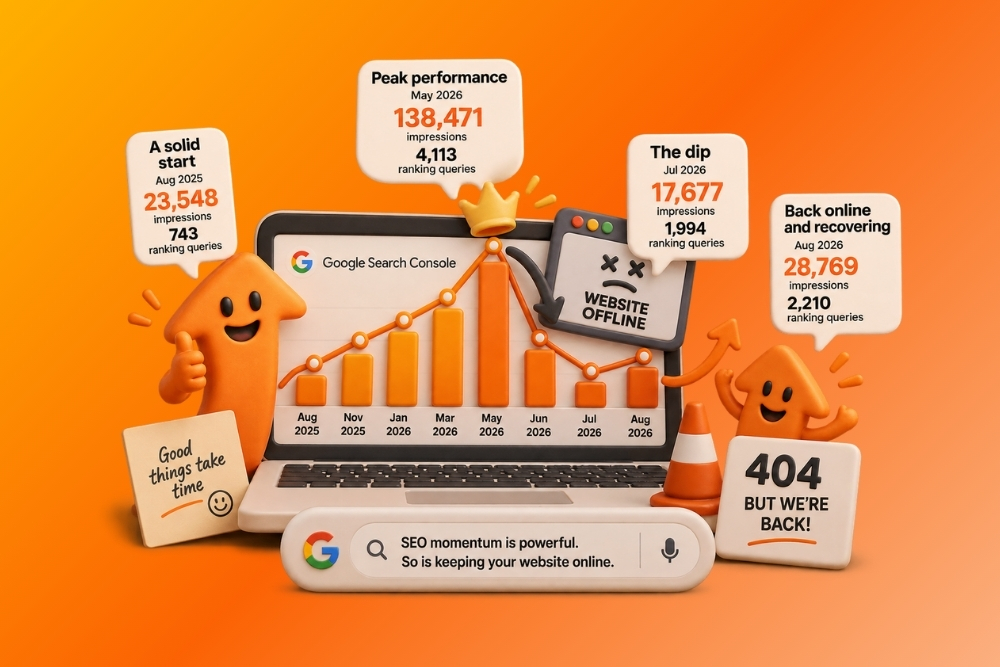
Search Console helps businesses analyse performance changes. It highlights shifts in impressions, clicks, and average search ranking, making it easier to identify the impact of a Google update.
Complete Timeline: History of Google Algorithm Updates
To understand how Google Search has evolved, you need more than a list of updates. You need a structured timeline that shows how each Google algorithm update fits into broader algorithm changes.
This section breaks down the history of Google algorithm updates by year and month. It highlights every confirmed core update, spam update, and major Google update, along with what changed and why it matters for search ranking.
2026 Google algorithm updates
Google’s 2026 updates show a clear shift towards AI search and stricter quality control. The focus is on reducing spam in search results while improving relevance through advanced ranking algorithm systems.
March 2026 core update
The March 2026 core update (Google March 2026 core update) introduced significant changes to how the Google search algorithm evaluates content quality.
Google began rolling out improvements tied to AI-driven understanding of search queries. This resulted in noticeable search ranking volatility across industries.
Key impacts included:
- Greater emphasis on content depth and originality
- Reduced visibility for sites relying on outdated SEO tactics
- Increased importance of topical authority
Many websites reported a drop in search performance, particularly those with thin or duplicated content.
March 2026 spam update
The March 2026 spam update (Google March 2026 spam update) targeted manipulative practices within the search engine.
This Google spam update focused on:
- Link spam and unnatural backlink patterns
- AI-generated low-value content at scale
- Sites attempting to manipulate search rankings
The update improved the quality of search results by removing low-quality pages from rankings.
May 2026 core update
The May 2026 core update (Google May 2026 core update) refined how AI evaluates helpful content.
This core algorithm update built on previous core updates by:
- Strengthening people-first content signals
- Improving interpretation of complex search queries
- Enhancing relevance in AI search results
Businesses that aligned with helpful content principles saw gains in Google search ranking, while others experienced continued fluctuations.
2025 Google algorithm updates
In 2025, Google updates continued refining the balance between AI, content quality, and user intent. The search engine became more effective at identifying genuinely helpful content.
March 2025 core update
The March 2025 core update introduced improvements to the ranking algorithm focused on intent matching.
Key changes included:
- Better alignment between content and search queries
- Reduced reliance on keyword-heavy optimisation
- Stronger evaluation of expertise and trust signals
This update reinforced the long-term direction of Google search towards meaningful content.
June 2025 core update
The June 2025 core update (also referred to as the June core update) expanded on earlier algorithm changes.
It focused on:
- Refining content relevance across industries
- Improving local search results and contextual accuracy
- Enhancing consistency in search ranking updates
Businesses with strong topical authority benefited the most.
September 2025 core update
The September 2025 core update introduced further refinements to how Google search ranking systems interpret content depth and usefulness.
This Google core update focused on:
- Prioritising comprehensive, well-structured content
- Improving evaluation of supporting content across a website
- Reducing visibility for fragmented or overly siloed pages
Many businesses saw moderate search ranking volatility, particularly those with inconsistent content quality.
October 2025 core update
The October 2025 core update followed closely, signalling Google’s move towards more continuous algorithm changes rather than isolated updates.
Key impacts included:
- Faster recalibration of ranking signals across the search engine
- Greater emphasis on consistency across entire domains
- Improved handling of overlapping or competing pages
This update rewarded sites with clear content hierarchies and strong internal linking.
November 2025 core update
The November 2025 core update focused on strengthening trust and content reliability within the Google search algorithm.
It introduced:
- More weight on credibility and content accuracy
- Improved detection of outdated or misleading information
- Stronger alignment with user expectations in search results
For many businesses, this update highlighted the importance of regularly reviewing and updating existing content.
December 2025 core update
The December 2025 core update highlighted the growing role of AI in the Google search algorithm.
This update:
- Strengthened AI search capabilities
- Improved understanding of conversational queries
- Reduced visibility for low-value automated content
It marked a major step towards fully AI-integrated search results.
2024 Google algorithm updates
The 2024 core update cycle was one of the most impactful in recent years. Google focused heavily on reducing low-quality content and improving the quality of search results.
March 2024 core update
The March 2024 core update was one of the largest broad core updates in Google history.
It targeted:
- Scaled content created for ranking manipulation
- Low-value pages lacking originality
- Poor user experience signals
This update caused widespread search ranking volatility and reshaped many industries.
August 2024 core update
The August 2024 core update refined earlier changes introduced in March.
It focused on:
- Improving consistency in ranking algorithm decisions
- Rewarding high-quality, experience-driven content
- Strengthening signals tied to expertise and authority
November 2024 core update
The November 2024 core update further adjusted how Google evaluates content relevance.
Key improvements included:
- Better alignment with user intent
- Enhanced handling of niche and specialised topics
- Reduced fluctuations compared to previous core updates
December 2024 core update
The December 2024 core update continued refining content quality signals.
It reinforced:
- Helpful content update principles
- Stronger filtering of redundant content
- Improved stability in search ranking
December 2024 spam update
The December 2024 spam update targeted spam in search results more aggressively.
This Google spam update addressed:
- Hidden links and cloaking techniques
- Expired domain abuse
- Large-scale content manipulation
It helped improve trust in Google search results across sectors.
2023 Google algorithm updates
The 2023 updates marked a transition towards AI-led search and more frequent Google algorithm updates.
August 2023 core update
The August 2023 core update introduced early signals of AI-driven ranking improvements.
It focused on:
- Content relevance and usefulness
- Reducing low-quality search results
- Improving consistency in ranking updates
September 2023 helpful content update
The September 2023 helpful content update reinforced Google’s people-first approach.
This update:
- Targeted content created purely for SEO
- Rewarded genuinely helpful and original content
- Reduced visibility for unhelpful pages
It became a cornerstone of modern Google search ranking strategy.
October 2023 core update
The October 2023 core update followed quickly after previous core updates, increasing search ranking volatility.
It focused on:
- Fine-tuning ranking algorithm signals
- Improving content evaluation accuracy
- Enhancing relevance for complex queries
Earlier Google algorithm updates and foundations
Before 2023, Google introduced several foundational updates that shaped the modern search engine.
First core update and early algorithm changes
The first core update concepts emerged in the early 2000s. Google began shifting away from simple keyword matching.
Updates like Florida changed how the search algorithm handled manipulation, laying the groundwork for future Google algorithm updates.
Key milestones in the evolution of Google search
Major updates included:
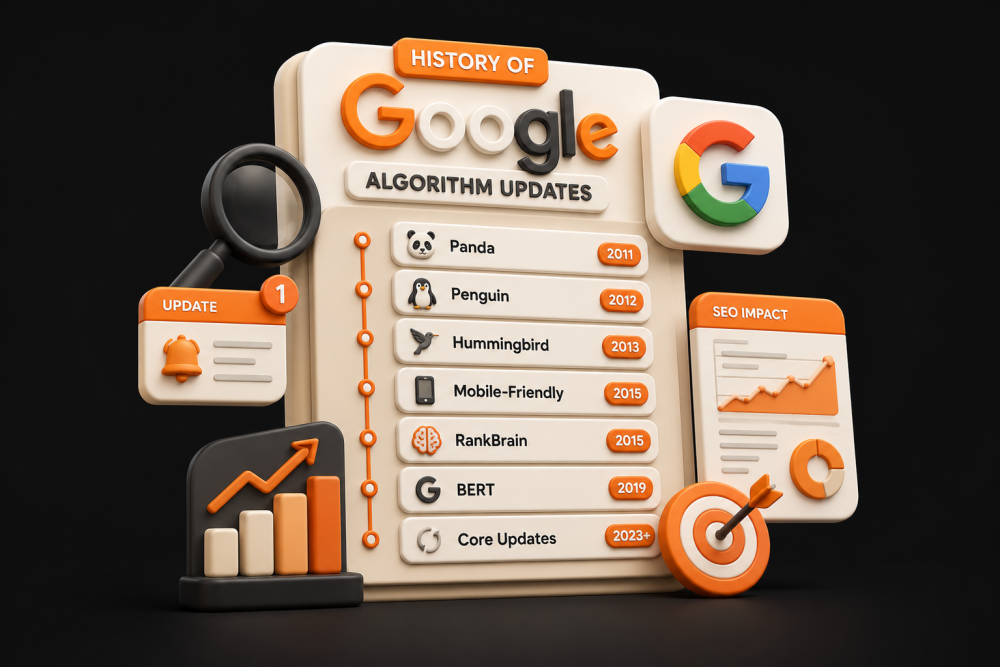
- Panda: focused on content quality
- Penguin: targeted link spam
- Hummingbird: improved understanding of search queries
These updates introduced the principles that still guide Google search today.
What this timeline means for your SEO strategy
The history of Google algorithm updates shows a clear trend. Google is prioritising quality, relevance, and AI-driven understanding.
For businesses, this means:
- Short-term tactics no longer deliver consistent results
- Algorithm changes reward long-term value and expertise
- Monitoring updates via the Search Status Dashboard and Search Console is essential
Adapting to these changes is the key to maintaining stable search ranking and long-term visibility.
What this timeline reveals about Google algorithm changes
The history of Google algorithm updates shows a clear direction. Google search has moved from basic ranking signals to a sophisticated AI-driven search engine.
Modern updates focus on:
- Delivering relevant search results based on intent
- Reducing spam and manipulation in search ranking
- Rewarding helpful, high-quality content
- Continuously improving the search algorithm through AI
For businesses, this means adapting to ongoing Google updates rather than chasing short-term ranking gains. Long-term success depends on aligning with how the Google search algorithm evaluates quality and relevance.
Key Algorithm Updates That Shaped Search Ranking
Not all Google algorithm updates have the same impact. Some fundamentally changed how the search algorithm works and reshaped Google search ranking for years.
Understanding these updates helps businesses prioritise what actually matters for long-term visibility.
Helpful content update and people-first content
The helpful content update marked a clear shift in Google search. It prioritises content created for users rather than search engines.
This update evaluates site-wide quality. If a large portion of your content lacks value, your entire domain can be affected.
Product review update and ecommerce quality signals
The product review update focuses on depth, expertise, and originality. It rewards detailed reviews with real insights.
Thin affiliate content saw a drop in search ranking. Meanwhile, brands investing in genuine reviews gained visibility in search results.
Page experience update and performance signals
The page experience update introduced user experience as a ranking factor. It includes loading speed, mobile usability, and visual stability.
This update reinforced that technical performance directly influences Google search ranking.
Spam update and quality enforcement
Spam updates target manipulation tactics. This includes unnatural links, keyword stuffing, and low-quality pages.
Recent updates like the December 2024 spam update and Google March 2026 spam update show Google’s continued focus on cleaning up search results.
Broad core updates and ranking recalibration
A broad core algorithm update reassesses content quality across the web. Updates like the March 2024 core update and May 2026 core update reshaped visibility across industries.
These updates do not target specific issues. Instead, they refine how the ranking algorithm evaluates relevance and quality.
Stay ahead of the next update
If your rankings feel unpredictable or you’re unsure what to fix, we can help. Get in touch to turn Google updates into clear, actionable growth opportunities.
The Role Of AI In Google Search Algorithm Updates
AI is now at the centre of the Google search algorithm. It influences how search results are interpreted, ranked, and delivered.
This shift has changed how businesses approach SEO and content creation.
How AI search is transforming search results
AI search allows Google to understand intent beyond keywords. It analyses context, behaviour, and meaning.
This results in more accurate and relevant search results, especially for complex or conversational queries.
Machine learning in ranking algorithm decisions
Machine learning models like RankBrain and BERT help Google process vast amounts of data.
These systems continuously learn from user interactions. This improves search ranking accuracy over time.
Impact of AI on content and search ranking
AI has reduced the effectiveness of outdated SEO tactics. Keyword stuffing and low-value content no longer perform well.
Instead, the Google search algorithm prioritises clarity, depth, and usefulness.
AI and future algorithm changes
AI will continue to drive algorithm changes. Updates like the Google March 2026 core update and Google May 2026 core update reflect this shift.
Businesses need to align with AI-driven evaluation rather than trying to outsmart the system.
What Causes A Drop In Search Ranking After A Google Update
A drop in search ranking after a Google update can feel sudden. However, it is usually the result of deeper issues exposed by algorithm changes.
Understanding the cause helps you respond effectively.
Content quality and relevance gaps
Core updates often highlight weak content. Pages that lack depth or originality may lose visibility.
This is especially common after broad core updates and helpful content updates.
Mismatch with search intent
If your content does not match search queries, rankings can drop. Google now prioritises intent over keywords.
This is a common reason for traffic loss after a search ranking update.
Technical and page experience issues
Slow loading speeds and poor usability affect rankings. The page experience update made this more important.
Technical issues can limit how the search engine crawls and evaluates your site.
Impact of spam signals
Spam signals can trigger ranking drops. This includes low-quality backlinks or duplicated content.
Updates like the December 2024 spam update and March 2026 spam update target these issues directly.
Normal search ranking volatility
Not every drop in search is a problem. Ranking updates often cause temporary fluctuations.
Search ranking volatility is common after major Google core updates.
How To Respond To A Google Algorithm Update
Reacting correctly to a Google algorithm update is critical. Many businesses make changes too quickly and worsen their position.
A structured approach leads to better outcomes.
Analyse performance using Search Console
Start with data. Use Search Console to identify which pages lost visibility.
Focus on impressions, clicks, and average Google search ranking.
Identify patterns across affected pages
Look for trends. Are specific topics, formats, or page types affected?
This helps you understand how the algorithm changes impact your content.
Improve content quality and relevance
Update pages to better match user intent. Add depth, clarity, and real value.
This aligns your content with how the Google search algorithm evaluates quality.
Strengthen technical performance
Review site speed, mobile usability, and structure. Technical improvements support better crawling and indexing.
Avoid reactive or rushed changes
Do not overhaul your site immediately. Wait for stability before making major decisions.
Google updates often take time to settle.
Common Mistakes Businesses Make After Updates
Many ranking losses are made worse by poor decisions after a Google update. Avoiding these mistakes can protect your search performance.
Overreacting to short-term changes
Immediate drops can lead to panic. Businesses often make unnecessary changes too quickly.
This can harm long-term search ranking.
Chasing algorithm loopholes
Trying to manipulate the search algorithm rarely works. Google updates consistently close these gaps.
Sustainable SEO focuses on quality, not shortcuts.
Ignoring user intent
Focusing only on keywords misses the bigger picture. Search intent is now central to ranking decisions.
Ignoring this leads to weak performance.
Neglecting technical SEO
Content alone is not enough. Technical issues can limit visibility regardless of quality.
The search engine needs to access and understand your content efficiently.
Best Practices For Long-Term Search Success
Long-term success in Google search comes from consistency. It is about aligning with how the algorithm evaluates quality over time.
Focus on helpful, high-quality content
Create content that answers real questions. Provide clear, practical value.
This aligns with the helpful content update and core algorithm updates.
Build topical authority
Cover topics in depth rather than creating isolated pages. This strengthens relevance and trust.
Maintain strong technical foundations
Ensure fast loading speeds, clean structure, and mobile optimisation.
These factors support better search ranking and user experience.
Monitor performance regularly
Track Google search ranking updates and performance trends. Use tools like Search Console to stay informed.
Adapt to ongoing algorithm changes
Google update cycles are continuous. Staying flexible helps you maintain visibility.
Future Trends In Google Search And Algorithm Changes
Google search is evolving rapidly. Understanding future trends helps businesses stay ahead of algorithm changes.
Growth of AI-driven search
AI search will continue to expand. It will play a larger role in ranking and content evaluation.
This includes more personalised and context-aware search results.
Increasing importance of trust and authority
Google is placing more emphasis on credibility. Signals related to expertise and trust will grow in importance.
Continuous core updates and refinement
Core updates will remain frequent. Each update will refine how the ranking algorithm evaluates content.
Expect more subtle but impactful changes.
Integration of new search experiences
Google is experimenting with new formats. This includes AI-generated summaries and enhanced search features.
These changes will influence how users interact with search results.
What Should You Do Next To Stay Ahead Of Google Updates
Staying ahead of Google algorithm updates requires a proactive approach. Waiting for a drop in search ranking is no longer enough.
Focus on building a strategy that aligns with how Google search works today. Prioritise quality, relevance, and user experience in every piece of content.
If you need expert guidance, SEOBoost can help you navigate algorithm changes and improve your Google search ranking. Get in touch with our team for tailored support.